- Printed Journal
- Indexed Journal
- Refereed Journal
- Peer Reviewed Journal

Journal of Pharmacognosy and Phytochemistry
Vol. 14, Issue 5 (2025)
Phytochemical standardization of Ipomoea mauritiana tuber extract using HPTLC
GN Pramodini and Surya S Nair
Background: Ipomoea mauritiana Jacq. (Convolvulaceae) is extensively employed in Ayurvedic drug preparations, but its phytochemical standardization is limited. High-Performance Thin-Layer Chromatography (HPTLC) provides a sensitive method for the development of chemical fingerprints and marker identification.
Methods: Tubers were extracted with 80% ethanol using Soxhlet apparatus. The extract was analyzed using HPTLC on silica gel 60 F254 plates using toluene:ethyl acetate:methanol:formic acid (5:5:1:0.3) as the mobile phase. Chromatograms were detected under UV at 254 and 366 nm, and scopoletin and quercetin standards were used.
Results: Ten peaks were recorded at 254 nm, the largest peak (Rf 0.87) corresponding to scopoletin. Six peaks were recorded at 366 nm, with no clear detection of quercetin, indicating trace amounts only.
Conclusion: Scopoletin was established as a major marker of I. mauritiana, and a reproducible HPTLC fingerprint was developed. The findings are a sound foundation for standardization, authentication, and quality control of its herbal products.
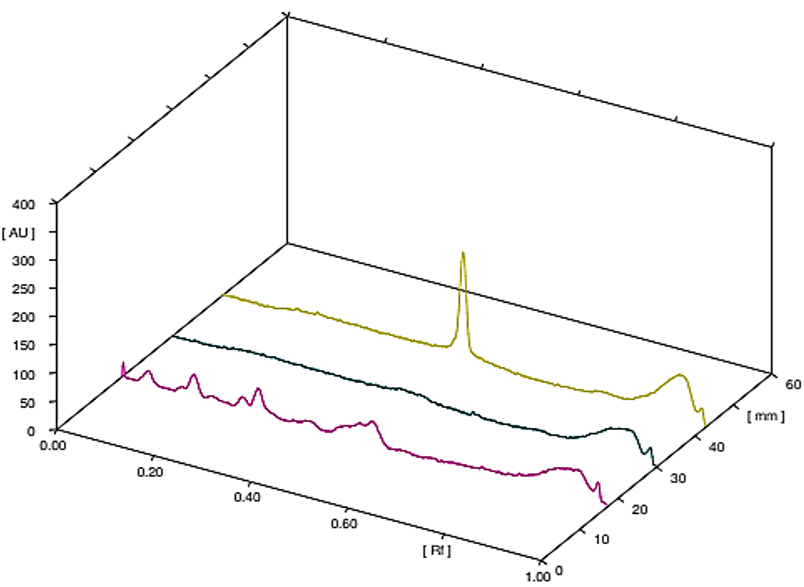
Fig. 1: 3D densitogram showing all the tracks of Ipomoea mauritiana tuber extract and standard markers at the wavelength 254 nm
Pages: 323-327 | 217 Views 93 Downloads





E-ISSN: 2278-4136
- P-ISSN: 2349-8234
- CODEN Code: JPPOHO
- Abbr: J Pharmacogn Phytochem
India (Tel): +91-9711224068
- Toll Free (India): 1800-1234-070