- Printed Journal
- Indexed Journal
- Refereed Journal
- Peer Reviewed Journal
Journal of Pharmacognosy and Phytochemistry
Vol. 14, Issue 5 (2025)
Evaluation of the glycemic reducing effect of the aqueous extract of Zea mays stigmas through oral stimulated hyperglycemia test
Kouamé Yao Yves, Miezan Bilé Aka Patrice and Kamagaté Tidiane
Oral glucose-induced hyperglycemia involves having the subject consume 75 grams of glucose, then measuring blood glucose levels 2 and 3 hours later. It allows observation of how the body responds after glucose ingestion. This study aims to evaluate the blood sugar-lowering effect of Zea mays stigmas on hyperglycemia. The aqueous extract of stigmas was obtained by decoction, and the toxicity test was conducted orally using mice of the species Mus musculus. Secondary metabolites were identified using the colorimetric method, while trace elements were analyzed using the calcination-mineralization method. Hyperglycemia was induced orally in mice of the species Mus musculus. The results showed that the extraction yield was 6.2% and that the contents of chromium, potassium, iron, zinc, magnesium, and copper were respectively: 0.39±0.10; 1651±0.84; 1.83±0.32; 61.17±0.43; 577.09±0.75; 157.58±0.68 µg/g of dry extract. Secondary metabolites such as alkaloids, saponins, polyphenols, flavonoids, gallic tannins, catechic tannins, and quinones were found in the said extract. The blood glucose of mice treated with the aqueous extract of Zea mays stigmas, at doses of 100 and 200 mg/kg of body weight, did not show any increase compared to the blood glucose of untreated mice. The study shows that the aqueous extract of Zea mays stigmas has blood glucose-lowering activity.
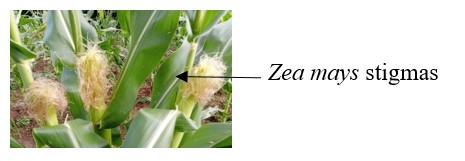
Fig. 1: Zea mays plant bearing ears topped with stigmas
Pages: 652-656 | 165 Views 69 Downloads




E-ISSN: 2278-4136
- P-ISSN: 2349-8234
- CODEN Code: JPPOHO
- Abbr: J Pharmacogn Phytochem
India (Tel): +91-9711224068
- Toll Free (India): 1800-1234-070