- Printed Journal
- Indexed Journal
- Refereed Journal
- Peer Reviewed Journal
Journal of Pharmacognosy and Phytochemistry
Vol. 14, Issue 6 (2025)
Comparative study of Crithmum maritimum L. richness on natural antioxydants: Effects of plant organ and geographic variation
Inès Jallali, Riadh Ksouri and Héla Ben Ahmed
Due to their negative side effects on human health, synthetic antioxidants and preservatives are increasingly being replaced by natural antioxidants, produced primarily by plants, such as phenolic compounds, essential oils, and vitamins. Crithmum maritimum L. is an edible halophyte potentially rich in these biomolecules. The present work aimed to investigate the richness of this plant on different classes of natural antioxidant (total polyphenols, flavonoids, condensed tannins, anthocyanins, carotenoids, essential oils, and ascorbic acid), and to study the effect of plant organ (root, stem, leaf, and umbel) ant geographic origin on the amount of these molecules. Colorimetric quantification divulged the high amounts of all the investigated compound classes except the anthocyanins, whose contents were weak. Results showed that leaves contained the highest amounts of phenolic compounds, ascorbic acid, and carotenoids; while umbels were the richest on essential oils and anthocyanins. Besides, the production of these molecules was significantly dependent on the geographic and bioclimatic conditions, underling their implication in biotique and abiotic stress defence. Thus, and due to its richness on natural antioxidants and many other nutrients, C. maritimum represent a potential candidate that can replace conventional foods in the Mediterranean diet and can promote human health and life quality.
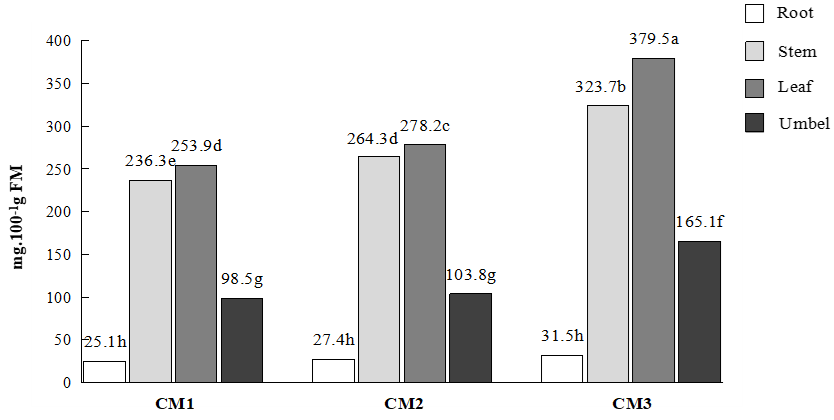
Fig. 1: Carotenoid contents in C. maritimum organs collected at three different bioclimatic stages in Tunisia.
Pages: 322-330 | 62 Views 20 Downloads





E-ISSN: 2278-4136
- P-ISSN: 2349-8234
- CODEN Code: JPPOHO
- Abbr: J Pharmacogn Phytochem
India (Tel): +91-9711224068
- Toll Free (India): 1800-1234-070