- Printed Journal
- Indexed Journal
- Refereed Journal
- Peer Reviewed Journal
Journal of Pharmacognosy and Phytochemistry
Vol. 15, Issue 1 (2026)
Review on carrot oil as potential alternative to retinol in acne treatment
Tanmay Wadate, Kalash Deshbhratar, Rahul Jadhav and VS Babu Agala
The most common dermatological condition is acne vulgaris, which occurs in almost 95 percent of teenage men and 83% of women between 12 and 25 years old and less in adults. It presents itself in the form of comedones, papules, pustules, nodules, and cysts, mostly on the face, neck, and back, and is linked to inflammation, pus, and psychological (anxiety and low self-esteem). The condition relates to the pilosebaceous follicle complex where the lipases, proteases, hyaluronidase, and cytokines such as IL-1, IL-8, and TNF-alpha add to tissue damages by the production of the ROS.
Traditional treatments such as topical retinoids, antibiotics, benzoyl peroxide and hormonal treatments are effective but have side effects such as antibiotic resistance, photosensitivity, skin irritation and disturbances in metabolism. In order to circumvent these constraints, the current research examines carrot seed oil extracted through hydro-distillation (30g seed/500mL water/ 4h) as a safe and more natural substitute to the synthetic retinoids.
The carotol-rich oil that is extracted exhibits strong antimicrobial action against P. acnes and S. epidermidis as well as antioxidant and anti-inflammatory potential by blocking NF-KB and pro-inflammatory cytokines. A carrot oil-based emulsion lotion developed using Tween 80 came up with the perfect pH, viscosity and spreadability, high antibacterial effectiveness, and non-irritant UV-protective qualities.
In this manner, carrot seed oil is an affordable, natural and multi-target approach to treating acne, which will need further research on bioavailability, stability, and optimization of formulation.
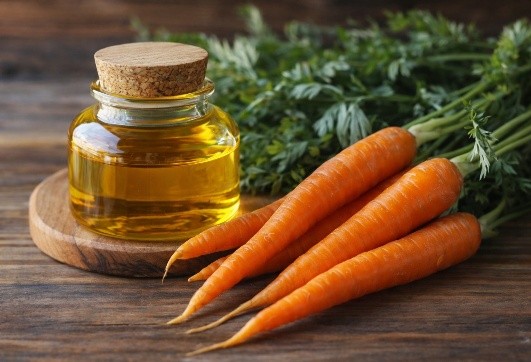
Fig. 1: Carrot Oil
Pages: 01-05 | 56 Views 15 Downloads





E-ISSN: 2278-4136
- P-ISSN: 2349-8234
- CODEN Code: JPPOHO
- Abbr: J Pharmacogn Phytochem
India (Tel): +91-9711224068
- Toll Free (India): 1800-1234-070