- Printed Journal
- Indexed Journal
- Refereed Journal
- Peer Reviewed Journal
Journal of Pharmacognosy and Phytochemistry
Vol. 15, Issue 1 (2026)
A review on herbal approaches for the management of mastitis
Falguni Bamankar, Sumbul Fatma Khan and Dr. VS Babu Agala
Mastitis is the most economically significant dairy cow disease, which results in low milk production and low milk quality with severe welfare effects. The conventional allopathic treatment is primarily founded on the administration of the antibiotics, such as β-lactams, cephalosporins, and fluoroquinolones. Although the agents remain effective in acute infections, the indiscriminate and chronic use has resulted in the creation of alarming percentages of antimicrobial resistance (AMR) and antibiotic residues in milk which is highly hazardous to human health. This has caused a scientific focus on polyherbal and phytotherapeutic alternatives as a possible change that can be employed to manage mastitis in a sustainable manner, left-over free.
The paper is a critical survey of pathophysiology of mastitis, the impacts it causes on cow health and dairy industry and a comparison of marketed allopathic and polyherbal preparations in treatment of mastitis. Topical polyherbal preparations with bioactive plant extracts of Curcuma longa, Aloe vera, Azadirachta indica, and Ocimum sanctum that have strong antimicrobial, anti-inflammatory, and immunomodulatory properties are given special attention. Also, the emerging nanoformulation technologies have been discovered to be superior in regards to bioavailability and acting on Multidrug-Resistant (MDR) mastitis pathogens. The recent research evidence indicates that polyherbal topical treatments can be used to relieve inflammation and infection in addition to healing the tissue of the udder and preventing relapse compared with antibiotics in case of chronic or subclinical cases. It means that the integration of herbal pharmacology and modern nanotechnology is one of those directions that will be studied in order to develop new generation environmentally friendly therapeutic agents against mastitis.
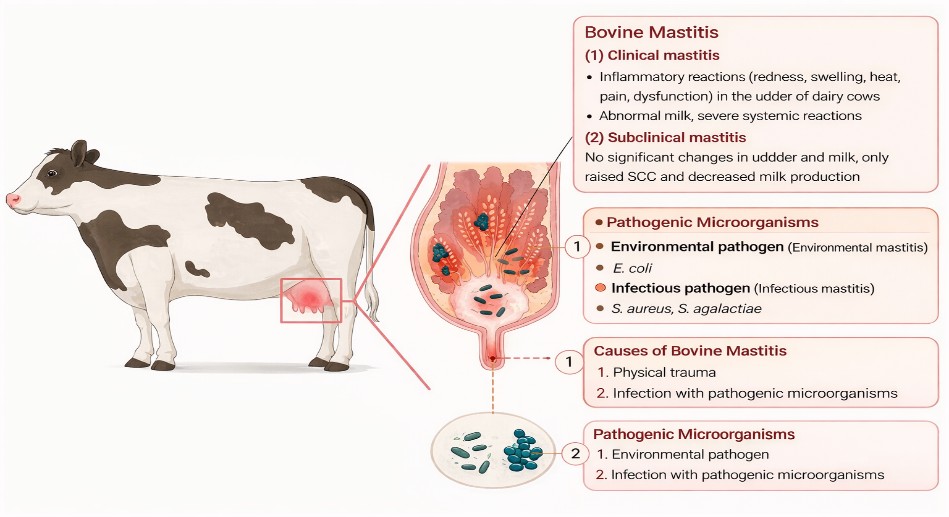
Fig. 1: Pathophysiology of mastitis
Pages: 09-14 | 70 Views 28 Downloads



E-ISSN: 2278-4136
- P-ISSN: 2349-8234
- CODEN Code: JPPOHO
- Abbr: J Pharmacogn Phytochem
India (Tel): +91-9711224068
- Toll Free (India): 1800-1234-070