- Printed Journal
- Indexed Journal
- Refereed Journal
- Peer Reviewed Journal
Journal of Pharmacognosy and Phytochemistry
Vol. 15, Issue 1 (2026)
Investigation of phytochemical and pharmacological activities of the ethanolic extract of Nyctanthes arbor-tristis leaves in swiss albino mice
Shaikat Mallick, Afia Ferdous, MD Abdul Mannan, MD Azizul Haque and MD Shafiqul Islam
Background: In Bangladesh, Nyctanthes arbor-tristis is frequently referred to as "Night Jasmine." Numerous ailments, including sciatica, rheumatism, internal worm infections, chronic fever, laxative, diaphoretic, and diuretic, are treated with the herb. The current study's goal was to use animal models to examine the antinociceptive effects of an ethanolic extract of Nyctanthes arbor-tristis leaves (EENA).
Methods: A wide range of mouse models of acute pain, including the hot plate, tail immersion, acetic acid-induced writhing, formalin, and glutamate-induced tests, were used to measure the antinociceptive activity. The conventional medications were administered intraperitoneally as diclofenac sodium (10 mg/kg) and morphine sulphate (5 mg/kg). Oral dosages of 50, 100, and 200 mg/kg of EENA were given, whereas the control group was given deionised water (0.1 mL/mouse, P.O.). These techniques evaluate potential antinociceptive substances or plant extracts using traditional nociception models.
Results: According to the current research, EENA strongly reflected the antinociceptive activity of all chemical and heat-induced pain models in mice. In contrast to thermal-induced nociception, 200 mg/kg showed a substantial (*p<0.05) ability to prolong the response of latency to pain in hot plate and tail immersion tests. The writhing test caused by acetic acid showed inhibitions of 13.31%, 43.42%, and 71.01%, respectively. The extract suppressed 15.00%, 35.00%, and 56.43% of the first phase of formalin-induced nociception. The extract showed 23.28%, 43.84%, and 57.54% licking in the late phase as compared to the control group. The glutamate-induced nociception test was significantly inhibited by the plant extract. 16.38%, 37.93%, and 61.21% of licking was inhibited during the first phase. When compared to the control, another phase resulted in a substantial inhibition of 30.28%, 53.21%, and 64.22%, respectively (***p<0.001).
Conclusions: It was discovered that Nyctanthes arbor-tristis leaf ethanolic extract has strong antinociceptive properties. According to the current study, the extract may be used in place of an analgesic medication. To determine the true molecular mechanism of the active ingredients in the leaf extract, more research is required.
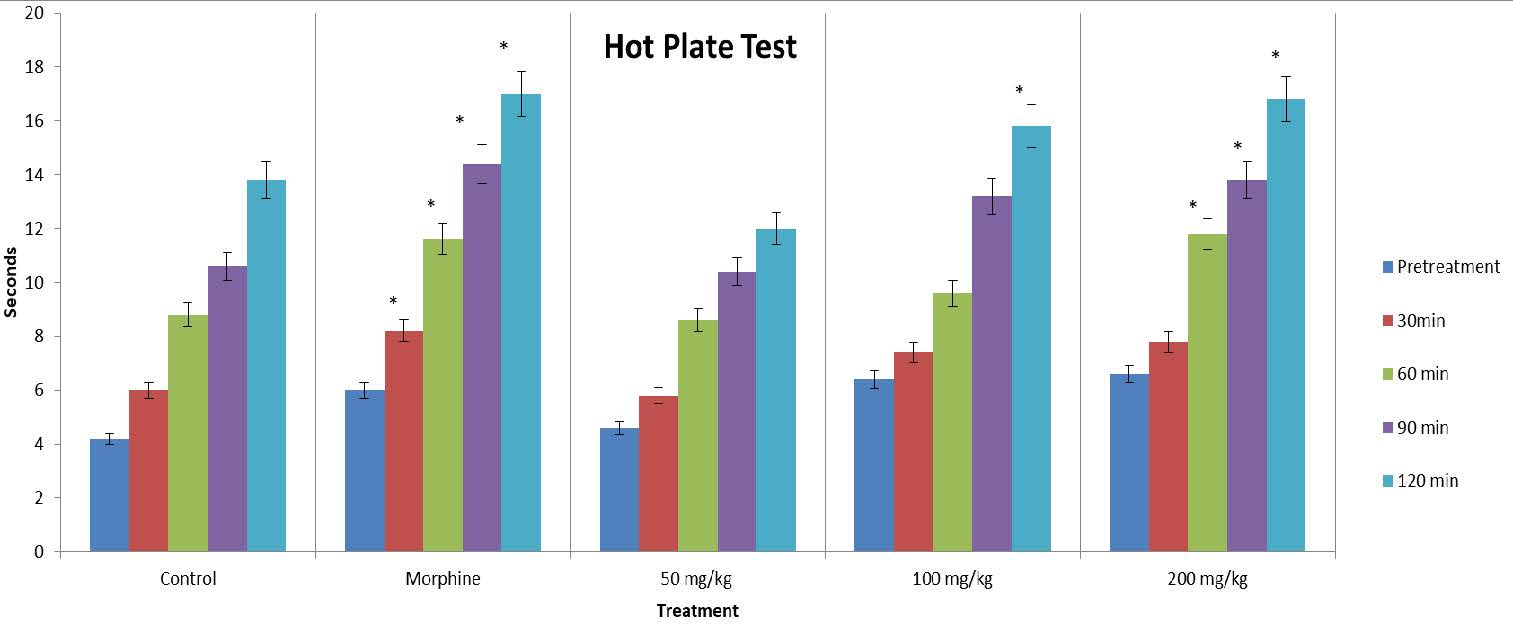
Fig. 1: Antinociceptive effect of Nyctanthes arbor-tristis leaves extract and morphine in hot plate test, values are presented as mean± SEM (N=5). *p<0.05 compared with the control group (ANOVA followed by post hoc Dunnett’s test).
Pages: 230-239 | 13 Views 3 Downloads





E-ISSN: 2278-4136
- P-ISSN: 2349-8234
- CODEN Code: JPPOHO
- Abbr: J Pharmacogn Phytochem
India (Tel): +91-9711224068
- Toll Free (India): 1800-1234-070